Choosing the right payment solution has a direct impact on your cash flow, operational efficiency, and how easily your customers can pay you.
GoCardless is widely used for Direct Debit payments, helping businesses automate recurring collections. SOTpay, developed by Gala Technology, is a complete payment platform that supports Direct Debit, Open Banking, cards, and multi-channel payments, with the added advantage of integrated financial workflows.
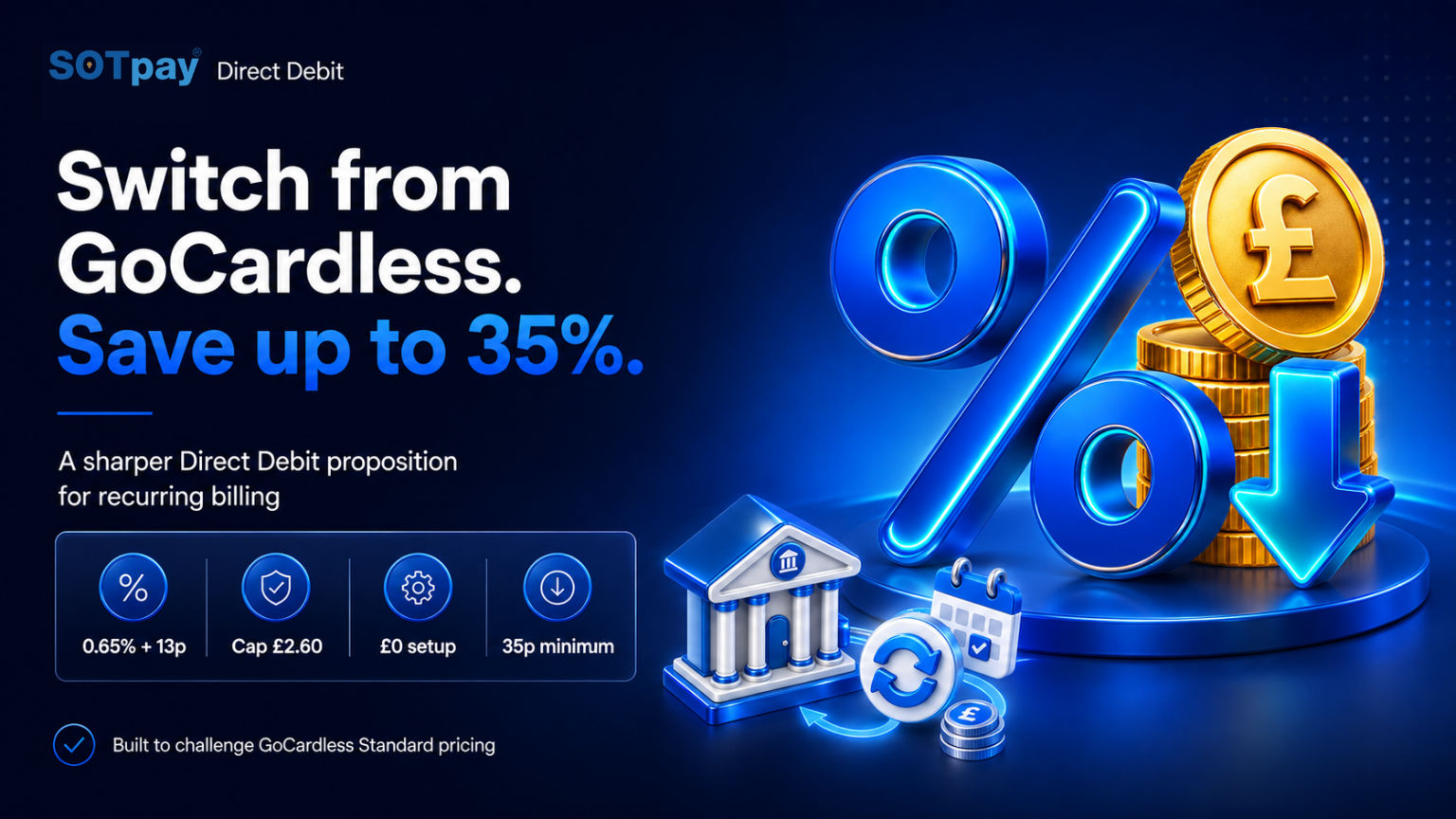
Businesses switching their Direct Debit collections to SOTpay can cut their costs by up to 35%, with simple predictable pricing, no setup fees, and quick onboarding. Bespoke deals are available for larger enterprise businesses.
Both platforms support payment collection, but they are built for very different levels of flexibility.
GoCardless is commonly used by businesses that:
SOTpay is designed for businesses that:
| Feature | SOTpay | GoCardless |
|---|---|---|
| Direct Debit payments | ✔️ Supported | ✔️ Core strength |
| Card payments | ✔️ Yes | ❌ Not supported |
| Open Banking payments | ✔️ Yes | ✔️ Supported |
| Multi-channel payments (SMS, phone, chat, social) | ✔️ Strong | ⚠️ Limited |
| Pay by link | ✔️ Core capability | ✔️ Available |
| Telephone payments | ✔️ Yes | ❌ Not supported |
| Ecommerce checkout | ✔️ Supported | ❌ Not designed for |
| Accounting integrations (Xero, QuickBooks) | ✔️ Integrated | ✔️ Strong |
| Payment flexibility | ✔️ High | ⚠️ Focused on Direct Debit |
GoCardless is built around Direct Debit, making it a strong choice for businesses that rely on recurring billing and predictable payment schedules.
SOTpay supports Direct Debit alongside a wider range of payment methods, allowing businesses to collect payments in multiple ways, depending on what works best for the customer and the situation.
While Direct Debit is effective for recurring payments, it isn’t always the fastest or most flexible way to get paid.
SOTpay enables businesses to:
This gives businesses more control over when and how they get paid, improving cash flow and reducing delays.
SOTpay enables payments across:
This allows businesses to take payments wherever conversations happen, rather than waiting for Direct Debit cycles.
Direct Debit is reliable, but it operates on fixed schedules and processing timelines.
SOTpay allows businesses to:
This is particularly useful for businesses dealing with one-off invoices, late payments, or ad hoc charges.
Both platforms support accounting integrations, but SOTpay goes further by connecting multiple payment types directly into systems like Xero and QuickBooks.
This means:
Explore Payment Automation Solutions.
As businesses grow, payment needs become more complex.
SOTpay allows you to:
Rather than relying on a single method, businesses can build a more flexible payment strategy.

Platforms focused primarily on Direct Debit are typically best suited for:
However, they may be more limited when businesses need:
Businesses switching to SOTpay can cut their Direct Debit costs by up to 35%.
The proposition is built around four things:
For businesses collecting regularly, the difference compounds. The more collections you process, the more the saving is worth over a year.
Bespoke pricing is also available for larger enterprise businesses.
The table below compares SOTpay against GoCardless Standard published pricing for UK Direct Debit collections. GoCardless Standard is 1% + 20p per collection, capped at £4. SOTpay is 0.65% + 13p, capped at £2.60, with a 35p minimum.
Both providers cap their fee, and neither charges a setup fee, so the difference is in the rate itself.
Figures are based on GoCardless published UK Standard plan pricing and are shown for comparison only. Your actual costs depend on your collection values and volumes, and on the plan you are currently on. Send us your pricing and we will model it properly.
SOTpay is most compelling for businesses running regular recurring collections, where the volume of payments makes the per-collection cost worth examining.
Best-fit sectors include:
Moving your Direct Debit scheme to SOTpay follows a simple route:
Onboarding is quick, and there are no setup fees to absorb before the savings start.
Send us your current Direct Debit pricing and we will model what the same collections would cost through SOTpay, so you can see the difference before committing to anything.
GoCardless is a strong choice for businesses focused purely on Direct Debit and recurring payments.
SOTpay supports Direct Debit while extending payment capability across multiple methods and channels, giving businesses greater control over how and when they get paid.
For businesses looking to improve cash flow, reduce admin, and build a more flexible payment strategy, SOTpay offers a broader and more scalable solution.
If your business relies on more than just recurring payments, expanding your payment capability can improve cash flow and reduce operational friction.
Explore SOTpay’s full range of Payment Solutions.

Need to ask a question: Request a callback from the team
Need merchant support? Visit Merchant Support